AI QUOTING · SALESFORCE
Turning quoting friction into a research-led AI roadmap.
I helped uncover the seller needs behind Salesforce’s quoting experience, identify guided quoting as a high-value opportunity for AI, and shape the research strategy for evaluating whether the new experience delivered meaningful value after release.
ROLE
UX Researcher · Research Strategy
SCOPE
Discovery → AI Opportunity Definition → Post-Release Measurement
RESEARCH
Interviews · AI Discovery · Feature Prioritization · Research Roadmapping
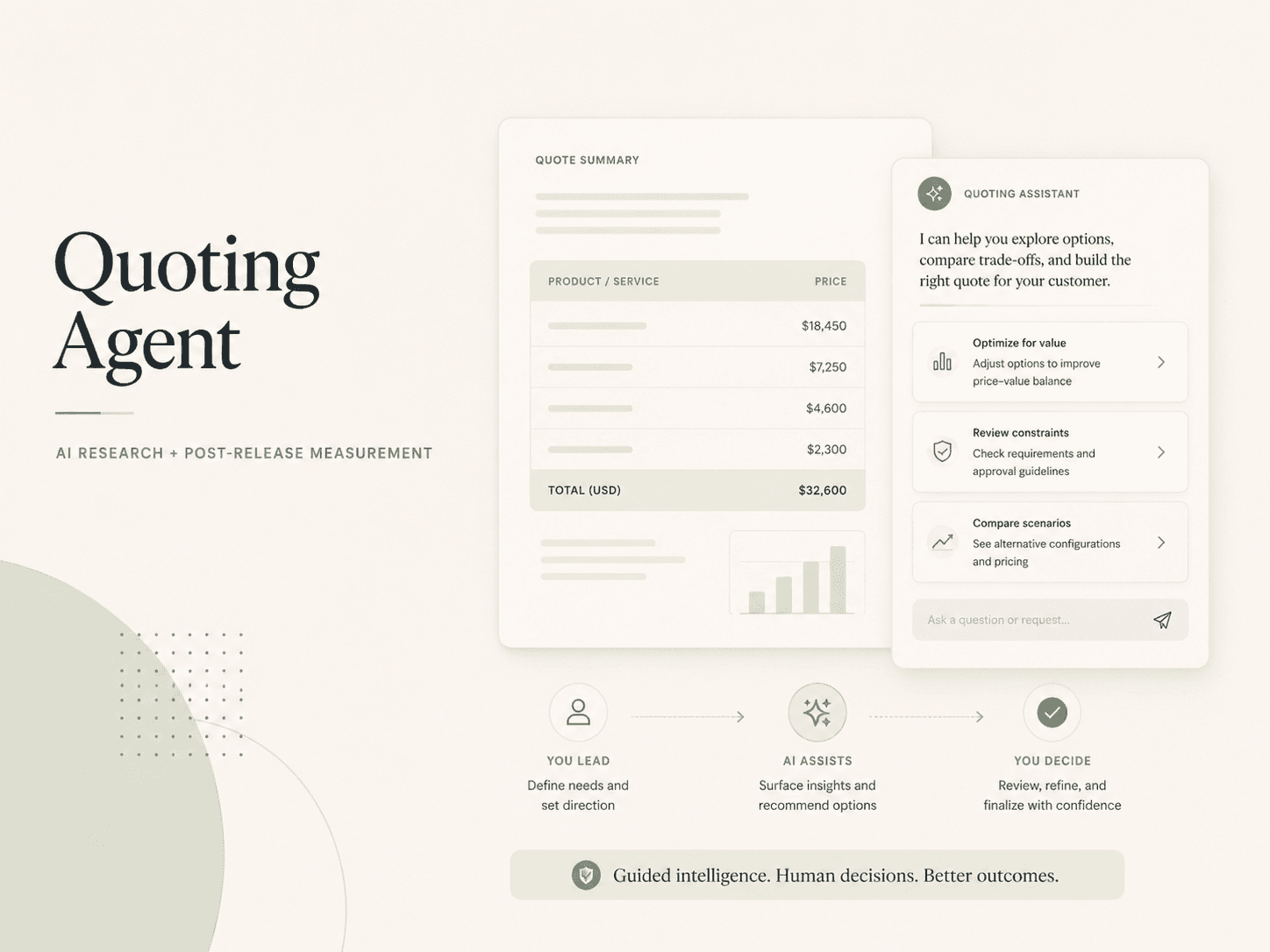
Some product visuals and details have been simplified or adapted to protect confidential information.
THE CHALLENGE
The problem wasn’t just creating quotes. It was the time, complexity, and uncertainty surrounding the entire process.
The initial research began with an existing quote-creation experience built on a web of external platforms. Near-term UX improvements were constrained to incremental fixes, while the longer-term opportunity was to understand what Account Executives actually needed from a rebuilt quoting experience.
The business stakes extended beyond usability. Sellers were losing valuable time to slow tools, manual approvals, confusing workflows, and limited system capabilities. Those inefficiencies also affected customers by extending sales cycles and, in some cases, putting deals at risk.
AE TIME
Reduce the time sellers spend navigating quoting complexity so they can focus more attention on selling.
CUSTOMER IMPACT
Reduce friction and delays that extend the sales process and negatively affect the customer experience.
DISCOVERY
Before designing the future experience, we needed to understand how sellers were quoting today.
I worked as part of the core research team to understand the existing quoting workflow, the problems Account Executives encountered, and the edge cases a future experience would need to support.
WHAT WE LEARNED
The research pointed to three things a better quoting experience needed to do.
01 · INCREASE SPEED
Make quoting dramatically faster.
Large and complex deals were slowed by tool performance and manual approvals. Sellers wanted a smoother flow with fewer unnecessary interruptions.
“I’ve spent up to 50 hours on one quote.”
- Senior Account Executive · 5 years experience
02 · CREATE CLARITY
Help sellers understand what went wrong and what to do next.
Confusing error messages, difficult support materials, and complex pricing rules forced sellers to rely on trial and error. The future experience needed clearer guidance, stronger support, and greater transparency.
03 · EXPAND CAPABILITIES
Move beyond fixing the old workflow.
Research surfaced needs that the existing tool could not reliably support, including mobile access, automation, complex quote scenarios, product bundling, and dependable draft creation.
THE NEXT QUESTION
The opportunity wasn’t simply to automate quoting. It was to determine where sellers would actually trust AI to help.
As AI-assisted selling became a larger product opportunity, the research expanded beyond the existing quoting workflow. We examined how sellers were already using AI, where agents were creating perceived value, where it fell short, and which high-effort workflows represented the strongest opportunities for intelligent assistance.
WHAT I NEEDED TO LEARN
Before automating more of the workflow, I needed to understand the boundary between user assistance and autonomy.
01 · VALUE
Where does AI already save sellers meaningful time or improve the quality of their work?
02 · TRUST
When do sellers trust AI-generated information, and when do they verify it manually?
03 · WORKFLOW
Which parts of the sales workflow are complex or repetitive enough to benefit from AI assistance?
04 · CONTROL
Where do sellers want automation, and where do they still want human judgment and guidance?
Value
Sellers already saw value in AI but mostly within a narrow set of tasks.
Sales Agent was valued for saving time on administrative work, case management, information retrieval, and customer preparation. But most Account Executives relied on it for only one or two consistent tasks and frequently compared it with external AI tools that better supported broader research or contextual work.
ADMINISTRATIVE WORK
Opportunity summaries, case creation, Deal Desk support
CASE MANAGEMENT
Automated case creation and routing
INFORMATION RETRIEVAL
Customer context, competitive information, product knowledge
CUSTOMER PREPARATION
POVs, account understanding, meeting preparation
THE PATTERN
Usage existed. Breadth of trust did not.
Trust
AI saved time when it worked. When it didn’t, sellers became the verification layer.
Research surfaced recurring reliability problems that limited deeper adoption. Sellers reported failed responses, inaccurate or conflicting information, generic answers, and inconsistent outputs that required manual verification.
FAILED RESPONSES
Complex queries sometimes returned no usable answer or next-step guidance.
INACCURATE INFORMATION
Conflicting or outdated information required manual cross-checking.
GENERIC OUTPUTS
Responses often lacked the nuance and context sellers expected from broader AI tools.
INCONSISTENCY
Different or unreliable outputs undermined confidence in the agent.
“Some of it looked like it was based on old information… I did try to cross-check that information.”
Salesforce Account Executive
Workflow
Sellers also needed clearer boundaries around what the agent could do.
UNCLEAR AGENT BOUNDARIES
The name “Sales Agent” suggested broader capabilities than the experience consistently supported.
NO INTELLIGENT HANDOFF
When users reached the wrong agent or asked an unsupported question, they received little guidance about where to go next.
SPECIALIZED PROMPT LANGUAGE
Successful interactions sometimes required Salesforce-specific terminology, creating additional friction.
Trust depended on more than accurate answers. Sellers needed to understand what the agent could do, when to rely on it, and what would happen when it reached its limits.
Control
Sellers wanted AI deeply involved in quoting. They just didn’t want it acting alone.
When sellers prioritized potential Sales Agent capabilities, quoting emerged as a particularly important but, nuanced opportunity.
HIGH-VALUE OPPORTUNITY
Comprehensive quoting assistance + product comparisons
Users identified complex quoting and nuanced product differences as an area where AI assistance could create significant value.
LOW-CONFIDENCE AUTOMATION
Create new business quotes — unassisted
Although quote creation was important, sellers had low confidence in fully autonomous execution and preferred guided assistance over untrusted automation.
ASSISTANCE ← HUMAN CONTROL → AUTONOMY
THE INSIGHT
The research pointed toward an AI experience that could help sellers navigate products, pricing, approvals, and complex quote scenarios without asking them to surrender judgment to a system they did not yet fully trust.
FROM OPPORTUNITY TO PRODUCT
Quoting became a concrete opportunity for AI-assisted selling.
Discovery into the existing quoting experience had already established speed, clarity, and complexity as major seller needs. The later AI research reinforced quoting as a high-value area for intelligent assistance while establishing an important design constraint: sellers wanted guidance and acceleration, not unchecked automation.
QUOTING FRICTION
↓
SELLER NEEDS
↓
AI OPPORTUNITY
↓
GUIDED QUOTING
↓
NEW QUOTING AGENT
The resulting Quoting Agent created a new research challenge: understanding whether the experience delivered sustained value after release.
POST-RELEASE RESEARCH
After launch, the question changed from ‘What should we build?’ to ‘How will we know it’s working?’
I developed a post-release research roadmap to monitor rollout health, identify adoption barriers, validate delivered value, and connect emerging evidence directly to future product decisions.
RESEARCH PRINCIPLE
Research needs a path to the roadmap—not just a report.
01
DISCOVER & STABILIZE
Monitor rollout
Identify early friction
Establish baselines
What needs fixing now?
02
VALIDATE & OPTIMIZE
Validate sustained value
Understand adoption + trust
Prioritize improvements
What should we improve or scale?
MEASUREMENT FRAMEWORK
Success required more than counting usage.
I structured measurement across six dimensions to understand whether the agent was being adopted, trusted, creating value, and ready to scale.
ADOPTION
Onboarding
Active + return usage
30 / 60 / 90-day retention
TRUST
Verification behavior
Confidence
Repeat usage
QUALITY
Errors
Interaction quality
Unresolved issues
EFFICIENCY
Time saved
Support reduction
Case / ticket volume
SATISFACTION
Satisfaction signals
Qualitative sentiment
SCALE READINESS
Support load
Documentation
Knowledge coverage
FROM MEASUREMENT TO ROADMAP
Every milestone answered a decision the product team needed to make.
LAUNCH
Health + baseline
What needs fixing immediately?
60 DAYS
Value validation
Is it delivering sustained value?
90 DAYS
Adoption + scale readiness
Are we ready to scale?
RETROSPECTIVE
Next-cycle synthesis
What should we prioritize next?
DAILY
Launch monitoring
WEEKLY
Issue prioritization
MONTHLY
Stakeholder alignment
30 / 60 / 90
Value validation
END OF CYCLE
Roadmap planning
MY CONTRIBUTION
DISCOVER
Understand the existing quoting experience and identify the root causes of seller friction.
FRAME
Use AI research and prioritization to define where intelligent assistance could create value—and where seller control remained necessary.
MEASURE
Build a repeatable post-release research roadmap connecting adoption, trust, quality, efficiency, and value back to product decisions.
REFLECTION
The best AI research doesn’t end with ‘Can the agent do it?’
Automation opportunity and automation readiness are not the same thing. Sellers saw significant potential for AI to simplify complex quoting, but they were more comfortable with guided assistance than unverified autonomy.
This project also reinforced that launch should begin the next research cycle—not end the previous one. By tying post-release research to explicit decisions, evidence could continue shaping the product as adoption, trust, and value emerged.